SCOTUS RULING
The U.S. Supreme Court's June 28, 2024, decision in City of Grants Pass v. Johnson, which upheld cities' ability to enforce camping and sleeping bans on public property without violating the Eighth Amendment's prohibition on cruel and unusual punishment Wikipedia+2Congress.gov+2
Broader Impacts and Other States The Grants Pass ruling has spurred similar challenges nationwide, with 2025 seeing more bans (e.g., in California cities like Merced with $50 fines) despite shelter shortages. In Arizona, a parallel Goldwater-backed case in Tucson (Bradford v. City of Tucson, May 2025 appeals ruling) held the city liable for encampment nuisances, reinforcing that municipalities can't "pass the buck" on enforcement. Arizona voter-approved Prop. 312 (2024) now allows property owners refunds for for Non-Enforcement of Public Nuisance Laws, with claims filed in affected areas.
Bottom line: The laws listed on this site are now far more enforceable — the constitutional roadblock has been removed, and there’s statewide pressure to enforce. Actual enforcement still depends on local government choices.
IS IT A CRIME TO BE HOMELESS?
ARIZONA
“To be homeless in Arizona is to be a criminal”
-
A person is committing loitering if they hang around in public or certain private places for the wrong reasons, including:
Asking someone to commit a sexual offense in public.
Trying to sell goods or services at a transportation facility after being told to stop.
Gambling in public places without authorization.
Being at a school, college, or university without permission or a legitimate reason after being asked to leave.
Soliciting bail bond business in or near a court or jail.
Penalties:
Loitering at schools/colleges (point 4) = Class 1 misdemeanor (more serious).
All other loitering offenses (points 1, 2, 3, 5) = Class 3 misdemeanor (less serious).
-
Public nuisances dangerous to public health
The following statute defines public nuisances as dangerous to public health including urinating on sidewalks.
PHOENIX
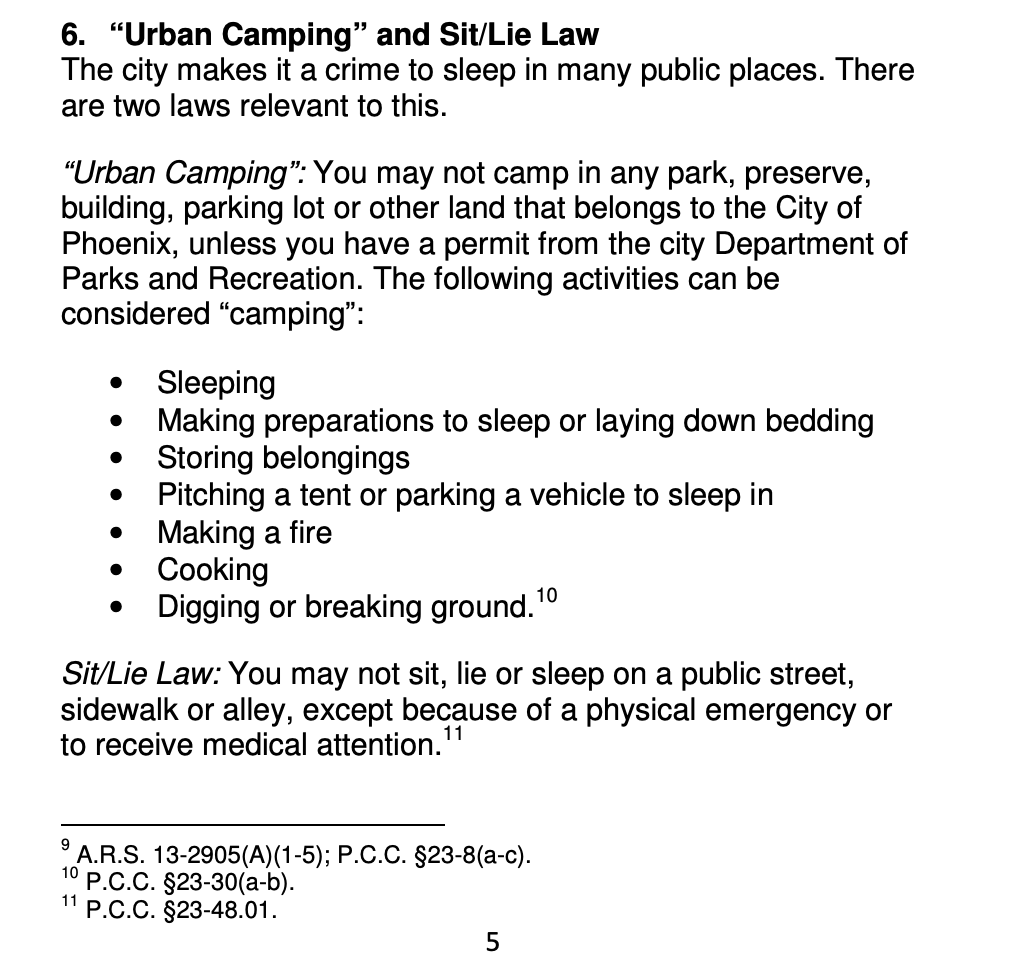
““The city makes it a crime to sleep in many public places.”
-
Prohibited use of public right-of-way.
It shall be unlawful for any person to use a public street, highway, alley, lane, parkway, sidewalk or other right-of-way, whether such right-of-way has been dedicated to the public in fee or by easement, for lying, sleeping or otherwise remaining in a sitting position thereon, except in the case of a physical emergency or the administration of medical assistance. (Ord. No. G-2238, § 1)
-
Phoenix, it’s illegal to camp or sleep on public streets, sidewalks, alleys, parks, or other city-owned land, and you can’t camp within 500 feet of schools, childcare centers, shelters, or city parks if there are signs or warnings. “Camping” includes sleeping, setting up tents or shelters, making fires, cooking, or storing belongings.
-
You can’t hang out on sidewalks if you block people from walking.
You can’t be in city parks or playgrounds after they are closed.
You can’t stay in public places like stores or restaurants if the owner or manager tells you to leave
PANHANDLING
-
Soliciting employment, business or contributions.
A. No person shall stand on or adjacent to a street or highway and solicit, or attempt to solicit, employment, business or contributions from the occupant of any vehicle.
B. A violation of this section is a Class 1 misdemeanor. In addition to any other penalties authorized by law, the court may order a person sentenced under this section to perform community service work. (Ord. No. G-2624, § 1; Ord. No. G-3983, § 2, 1997)
-
It shall be unlawful for any person to solicit any money or other thing of value, or to solicit the sale of goods or services:
1. In an aggressive manner in a public area.
2. Within fifteen feet of any entrance or exit of any bank or within fifteen feet of any automated teller machine (ATM).
3. In any public transportation vehicle or from persons waiting within ten feet of a sign designating a bus stop.
4. In a vocal manner in a public area between sunset and sunrise.
C. Penalty. A violation of this Section is a Class 1 misdemeanor. In addition to any other penalties authorized by law, the court may order a person sentenced under this Section to perform community service work. (Ord. No. G-3954, §§ 1, 2, 1996; Ord. No. G-4529, § 1, 2003)
-
Crossing or stopping in a roadway.
Prohibits pedestrians from stopping or remaining in medians, traffic islands, or the vehicular portion of roadways (which effectively prohibits panhandling in these areas). Violations start as a civil offense after a warning, escalating to a Class 1 misdemeanor.